Empowering Education

Igniting Minds, Changing Futures: Our education initiatives spark a passion for learning and provide students with practical life skills, nurturing self-reliance, and fostering community.

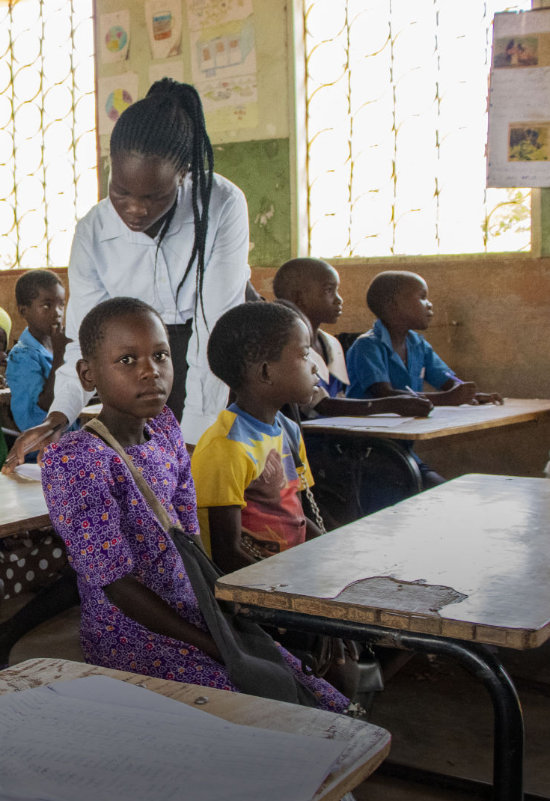
We understand the critical role of teachers in shaping the quality of education and ultimately impacting the development of communities. At four teacher training colleges, we train dedicated rural primary school teachers. We employ a learner-centred pedagogy in our educational initiatives, focusing on active participation, practical application, and holistic development. Our students go through theoretical and practical training that equips them with “skills, heart, courage, and wisdom” to take up the role of a teacher and community developer during their deployment.

We place significant emphasis on technical and vocational skills training as part of our education programs. Our technical and vocational training curricula are aligned to industry standards and requirements as they cover a wide range of skill areas, including carpentry, bricklaying, plumbing, tailoring, agriculture, and entrepreneurship, to mention a few. Overall, our aim is to equip youth with the necessary skills to become economically self- reliant by owning businesses and being employed.

In addition to the education institutions, other training programs are integrated in the various projects.


educational project dapp malawi

vocational school dapp malawi

Our Education Projects and Key Numbers 2025

Education districts

1.400+

Student Teachers undergoing training

950+

Trained under technical& vocational skills and business incubation

51,000+

Primary students benefitting

80+

ECD centres reached around our four Teacher Training Colleges.

Our Educational Projects in Malawi

Teacher Training in Malawi | DAPP Malawi

Teacher Training

We train primary school teachers who have a heart and passion to teach in rural areas where the education gap exists the most. Our teacher training approach, developed by Humana People to People, is tailored to the Malawian context with the national curriculum embedded into the program. We have been training primary schools teachers since 2003 based on the MoU that exist between Ministry of Education and DAPP.

Through our four DAPP Teacher Training Colleges; Amalika, Chilangoma, Dowa and Mzimba, 4,000 primary school teachers have been trained and have impacted thousands of learners and their communities.

The training programme is designed to create a new generation of teachers who will bring modern inclusive quality education into poor communities and contribute to social development. Student teachers go through a process during which they are equipped with the knowledge, skills, experiences, commitment and courage “to act” and to “do what it takes” to make the children benefit from going to school and indeed to be a teacher is ready to do what it takes to ensure that the children actually do learn, solve challenges and work closely with the learners, parents, teachers council and community to ensure a productive and child friendly learning environment. As Early Childhood Development programs are essential for children's development, learning and well-being, we support the local child care centres around our for DAPP Teacher Training Colleges by training the caregivers and creating partnerships to establish a child friendly environment with e.g playgrounds. We have also been accredited by the Ministry of Gender to train and certify caregivers. In 2023, we worked with 125 community-based ECD centres, trained 476 caregivers and over 1,950 children directly benefitted.

400 primary schools is a network of graduated teachers from DAPP Teacher Training Colleges in Malawi

400 Primary Schools

The idea behind “400 Primary Schools” is to provide opportunity to teachers who have graduated from DAPP Teacher Training Colleges and are now working in government primary schools to stick together and support each other in improving the learning environment in schools where they are working.

The teachers participate on voluntary basis and meet in monthly meetings and during production sessions three times per year. During this time, the teachers share ideas and plan for the upcoming school sessions. The project currently works with 189 primary schools across 26 out of 28 districts of Malawi, with 201 teachers on board. The program has significantly improved the learning environment and classroom management in those schools where the program exists. 

Teacher engaging learners through the TRIO Method during a classroom session

Upscaling Child-Centred Teaching in Malawi

We are implementing a two-year project supported by ENABEL under the EU's Regional Teachers' Initiative for Africa that incorporates the TRIO learning strategy to improve learning outcomes among students in 40 primary schools across Dowa District. The TRIO learning approach fosters students to organize themselves in groups of three and work collaboratively in solving various academic tasks. Over 18,000 students are to benefit under this program.

Through our four DAPP Teacher Training Colleges; Amalika, Chilangoma, Dowa and Mzimba, 4,000 primary school teachers have been trained and have impacted thousands of learners and their communities.

Beyond classroom interventions, the program provides leadership training for head teachers and education advisors while fostering community partnerships through Parent Teacher Associations and Mother Groups to ensure long-term sustainability. The project's unique approach combines structured peer learning frameworks, teacher coaching and feedback systems, regular community progress reviews and continuous monitoring and evaluation.

Vocational Training in Malawi | DAPP Malawi

Technical and Vocational Skills Training

Through our DAPP Mikolongwe Vocational School we have trained over 14,000 youth and given them technical and entrepreneurial skills to enable them to be self-reliant through formal training and self-employment. We offer ten courses; Agriculture, Bricklaying, Carpentry and Joinery, Cobbler and Shoe Making, Community Development, Cosmetology, Plumbing and WASH Technics, Renewable Energy and Electrical Installation, Textile and Fashion Designing, and Welding and Fabrication. 

The duration of the courses varies from short (informal) courses to formal courses of 3 months to three years.  To reach out to more  vulnerable and underprivileged potential youth who, due to geographical and socio-economic constraints, are unable to access formal education,  we introduced a TEVET Mobile Training Unit, a van which was modified to become a mobile classroom, workshop, office  and storeroom. We further equipped some of our four Teacher Training Colleges to become Satellite Centres for DAPP Mikolongwe  Vocational School offering courses in tailoring and shoemaking.

The school has also established itself as a business incubation centre and is working with various partners  including UNDP  and The International Centre for Tropical Agriculture (CIAT)  and others.

In 2024 we have started training youth to also repair and upgrade  second-hand clothes for further use,  – skills which they can also use as tailors, enabling them to earn more income for sustaining their life and the life of their families.


Welding And Fabrication

Welding And Fabrication

Bricklaying

Bricklaying

Cloths Making and Repairs

Cloths Making and Repairs

A total of 100 youth with disabilities of which 75 are women will during year 2025 be trained in skills for  them to become economically empowered

Inclusive Fostering of Capacity now – I CAN!

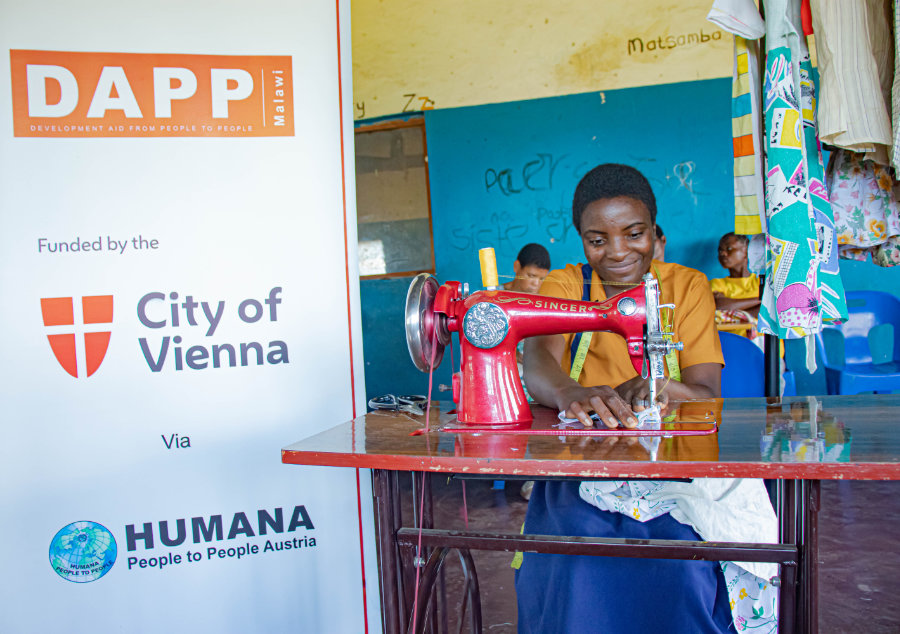
With support from the City of Vienna through Humana Austria we are empowering vulnerable young women and promoting integration of people living with disabilities. The idea of the project is to enhance educational and socio-economic opportunities among students with disabilities at Mikolongwe Vocational School and surrounding villages.

A total of 100 youth with disabilities of which 75 are women will during year 2025 be trained in skills for them to become economically empowered. Through community and media campaigns, the project will conduct awareness-raising campaigns on the rights of people with disabilities, as well as the importance of inclusivity in the vocational school and in community activities. These campaigns are to challenge stereotypes, reduce stigma, and promote a culture of inclusivity and acceptance of people with disabilities within the communities. The project started in December 2024 and is to end in November 2025.

The project also aims to improve schools’ hygiene and sanitation, which affects attendance especially, particularly among early graders and girls

Building a brighter future for girls and children with disabilities.

Funded by the Finnish Ministry for Foreign Affairs through UFF Finland, this four-year (2025-2028) initiative seeks to transform learning opportunities for girls and for children with disabilities in Dowa District. 210 teachers in 21 schools across Boma, Kapita, and Mvera education zones will be equipped with specialized skills to create truly inclusive classrooms. The project will strengthen the primary school teachers pedagogical performance and creating conducive learning environments for 10,500 learners including those with disabilities. The project also aims to improve schools’ hygiene and sanitation, which affects attendance especially, particularly among early graders and girls. Together with the stakeholders we will advocate for accountability of rights and duty bearers to protect girls and learners with disabilities.
Implemented in partnership with the Federation of Disability Organisations in Malawi (FEDOMA) with technical support from Disability Partnership Finland and the initiative aims to create a replicable model for inclusive education that could eventually benefit schools nationwide.